Polymarket Review 2026: The Prediction Market for People Who Follow the News
Updated March 2026 · By PredictionCircle Editorial
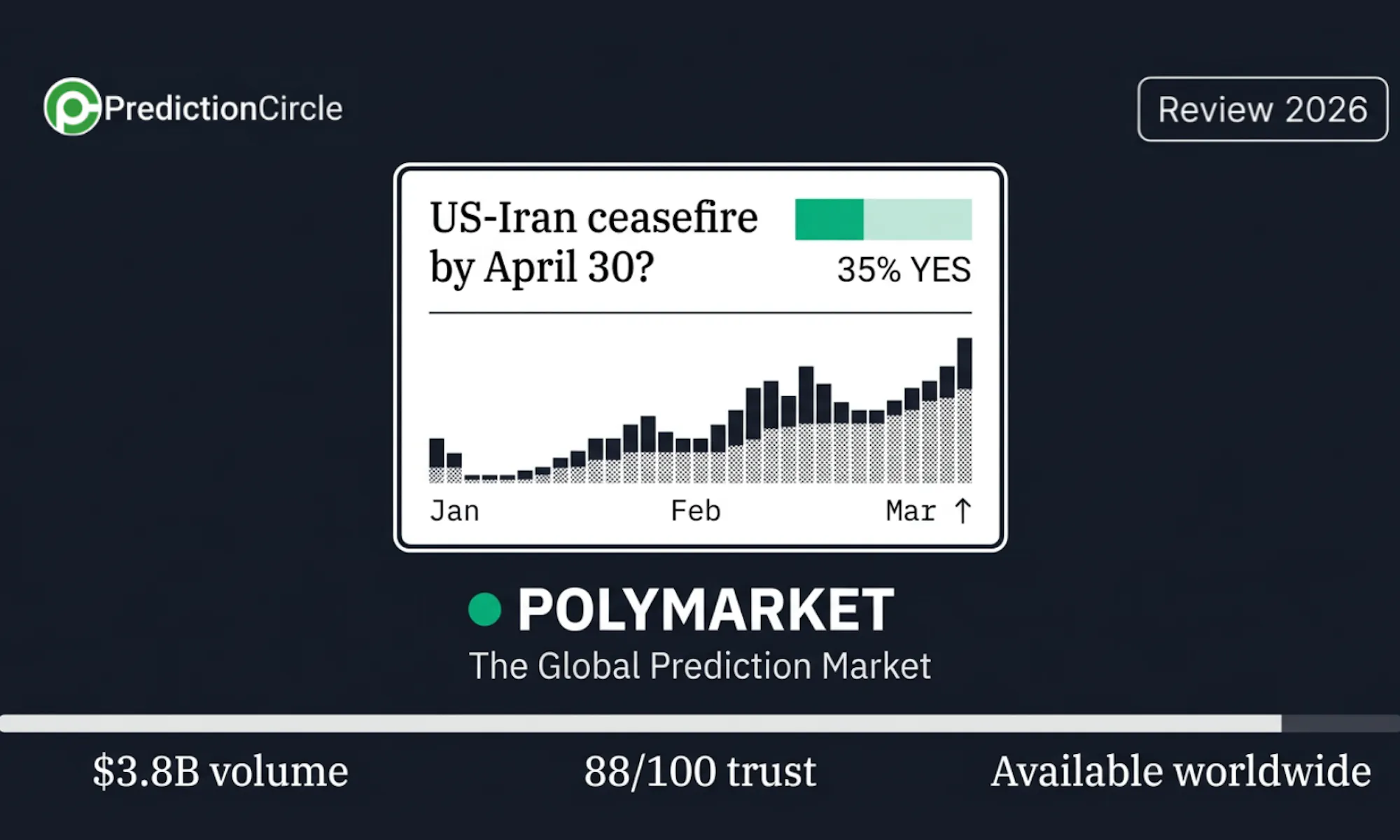
PredictionCircle Score
Best-in-class market variety and liquidity. Weakened by crypto-only funding friction, inconsistent support, and unresolved state-level legal battles.
PredictionCircle Editorial - March 2026
Editorial Verdict
Polymarket is where the sharpest prediction market action happens - $3.7 billion a week in trades, odds cited by the Wall Street Journal, and a track record of calling elections before the polls caught up. If you follow news and want to put real money behind your read, nothing else comes close. But it runs on crypto, customer support is essentially nonexistent, and it is currently suing Massachusetts, Michigan, and Nevada to stay legal - so the platform you fund today might be geoblocked in your state before your position closes.
Score Breakdown
| Category | Weight | Score | What it means |
|---|---|---|---|
| Regulation & transparency | 30% | 80 | CFTC-licensed since Nov 2025; prior $1.4M penalty; actively fighting 10+ states in court |
| Market integrity & resolutionBest | 25% | 85 | Deepest global liquidity by far; UMA oracle disputes are a known, recurring flaw |
| Payments & withdrawals | 25% | 72 | Crypto-to-wallet withdrawals are fast and reliable; banking partner cashouts have stranded five-figure balances for weeks |
| User sentiment & safety | 20% | 78 | Institutional credibility is real; support is email-only with days-to-weeks response times |
Methodology: PredictionCircle scores combine regulatory standing, payment reliability, market quality, and community sentiment. We do not accept payment from platforms we review.
- ✓Deepest liquidity on major events globally - often 10x more volume than competitors
- ✓Near-zero trading fees on most markets (0.1% on US platform; free on global)
- ✓30,000+ markets across politics, sports, crypto, culture, economics
- ✓Real-time odds cited by Wall Street Journal, CNN, and Bloomberg
- ✓Mobile app rated 4.8/5 on iOS
- ✗Requires USDC (a stablecoin) - no direct bank deposits on the global platform
- ✗US access still rolling out via waitlist; not all markets available
- ✗Customer support is slow - email-only, no phone, weeks-long wait times reported
- ✗State-level legal fights in Nevada, Massachusetts, New York, California, Tennessee
- ✗Oracle-based dispute resolution has produced controversial outcomes
What Is Polymarket and How Does It Work?
Polymarket is a prediction market where you trade contracts on whether real-world events will happen. Each contract is priced between $0.01 and $0.99, and that price represents the crowd’s estimate of how likely the outcome is. If a contract trades at $0.65, the market believes there’s a 65% chance it happens. If you’re right, each contract pays out $1.00. If you’re wrong, it pays $0.
Think of it like putting $5 on a soccer match with friends - except the “match” can be a Fed interest rate decision, a presidential election, or whether the next iPhone will cost more than the last one. You’re not betting against a bookmaker. You’re trading against other people who disagree with you about what’s going to happen.
How a trade works in five steps
Polymarket lists thousands of events across politics, sports, economics, crypto, culture, and more. Each market is framed as a yes-or-no question: “Will the Fed cut rates in June?”
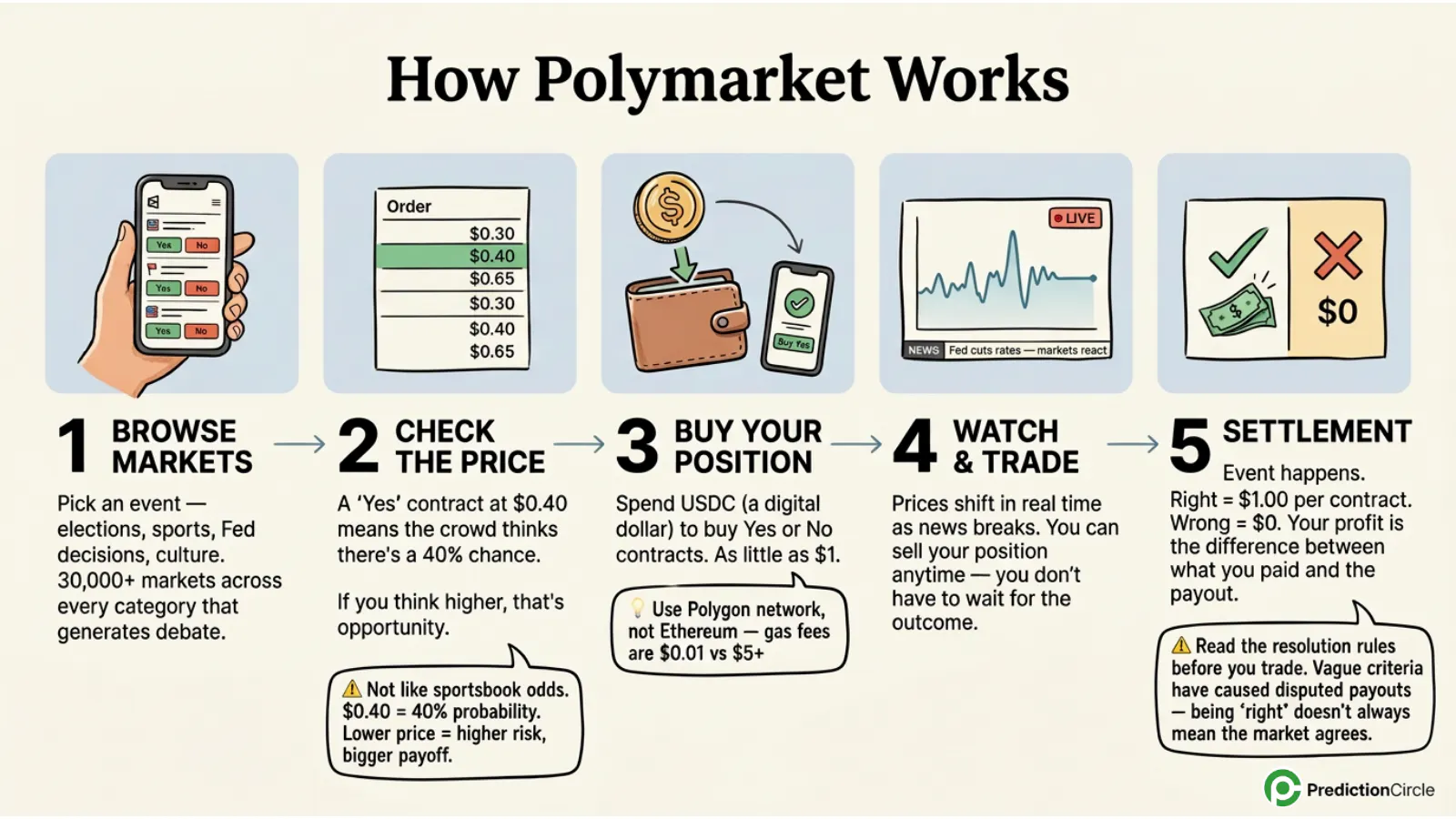
How Polymarket works: 5-step illustrated process from browsing markets to settlement
Is Polymarket gambling?
Polymarket is legally classified as a derivatives exchange, not a sportsbook or casino. You’re trading event contracts, not placing bets with a house that sets odds against you. There’s no house edge - every dollar you win comes from another trader who lost. However, the experience can feel like betting, especially on sports and culture markets. Several state regulators have argued exactly that, which is why legal battles are ongoing in Nevada, Massachusetts, and elsewhere. Whether you call it trading or betting, the financial risk is the same: you can lose 100% of what you put in.
Is Polymarket legal where I live?
In the United States, Polymarket is federally legal under CFTC oversight as of November 2025. The platform acquired a CFTC-licensed exchange (QCX) and received an Amended Order of Designation to operate as a regulated contract market. US users access the platform through a separate regulated portal with KYC requirements and trade through approved brokers.
However, several states are challenging this. Nevada’s Gaming Control Board filed a civil complaint in January 2026. Massachusetts issued a preliminary injunction against prediction market sports contracts. New York is preparing legislation (the ORACLE Act) that could ban event trading on elections and major world events. California regulators are investigating. Tennessee has sent cease-and-desist letters.
Outside the US, the global Polymarket platform operates without traditional financial regulation. It’s accessible in most countries using a crypto wallet, with no KYC required. It is blocked in France, and restrictions apply in several other jurisdictions.
Bottom line: Federally legal in the US, but your state may disagree. If you’re outside the US, access depends on local crypto and gambling laws. Check before you fund.
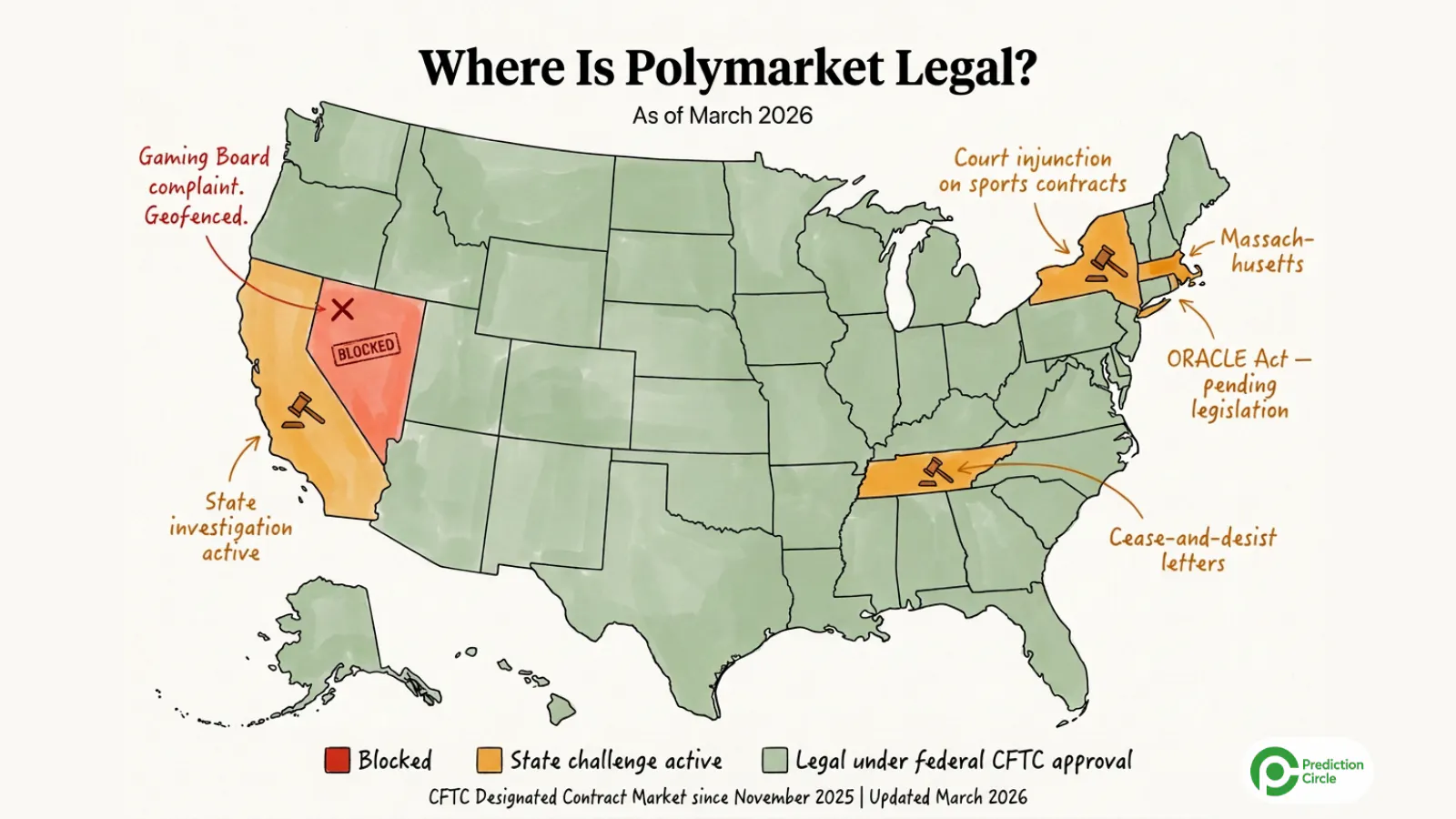
Polymarket US legal status by state - March 2026 map showing federal approval and state challenges
Who Is Polymarket Really For?
Different users, different verdicts.
The News Conviction Trader
I follow every headline. I want to put money behind my take.
Polymarket was built for you. When Biden dropped out, Polymarket showed a 70% probability weeks before mainstream media caught up. When the Fed cut rates by 50bps, Polymarket called it while Wall Street consensus was 25. If you consume information faster than the crowd adjusts, you’ll find opportunities here. The risk: emotional conviction is not the same as informational edge. Markets move fast, and being right on the direction but wrong on the timing can still cost you everything.
The Signal Watcher
I use market odds to track what people actually believe, not what pundits say.
You don’t need to trade a single dollar to get value from Polymarket. The prices themselves are information. When a contract on “US recession in 2026” trades at $0.32, that’s a real-time consensus built by people with money on the line - more honest than any poll or pundit prediction. Google, CNN, CNBC, and the Wall Street Journal all now display Polymarket odds. Nate Silver became an advisor. The platform’s data has become a primary source for how informed people understand probability.
The Fun Stakes Fan
I want to throw $5 on the match I’m watching with friends.
Having $5 on a Champions League semifinal makes the 89th minute feel different. That’s what Polymarket offers here. The catch: the crypto funding requirement adds friction that a $5 fun bet doesn’t justify for most people. If you already have a crypto wallet, the experience is smooth. If you don’t, setting one up for a $5 position isn’t worth it. Consider Kalshi for a simpler fiat on-ramp.
What Can You Trade on Polymarket?
Polymarket hosts over 30,000 active markets across every category that generates public debate. It’s the broadest prediction market in the world by market count, and political and sports markets drive the highest volume.
Politics and elections: Presidential races, midterms, Supreme Court decisions, government shutdowns, international elections. Polymarket had $3.3 billion wagered on the 2024 presidential race alone. In January 2026, 191 new geopolitics markets were created - a 260% year-over-year increase.
Sports: Markets launched on the US platform in early 2026, currently covering NFL, NBA, MLB, NHL, and select Champions League and Premier League fixtures - with more leagues added monthly.
Economics and finance: Fed rate decisions, CPI prints, GDP numbers, recession odds, crypto price targets. If you care about macro, this is where traders put money behind their models.
Culture and entertainment: Oscar winners, Spotify top artists, viral moments, celebrity events. These tend to be lower-volume but high-engagement markets.
Crypto: Bitcoin price milestones, protocol upgrades, exchange events, meme coin outcomes. Polymarket introduced taker fees (up to 3%) on 15-minute and 5-minute crypto prediction markets to combat wash trading.
The weird and wonderful: “Will Elon Musk tweet more than 200 times this week?” “Will a UFO be officially confirmed by 2027?” These novelty markets draw attention and social sharing, though liquidity is usually thin.
Polymarket vs. Kalshi: Which is better for what?
| Feature | Polymarket | Kalshi |
|---|---|---|
| Global politics and election trading | ✅ Dominant - deepest liquidity worldwide | Available but lower volume |
| US sports (NFL, NBA, MLB) | Growing - expanding coverage | ✅ Wider sports coverage, single-game moneylines |
| Economics and macro (CPI, Fed, GDP) | Strong | ✅ Built for this - weather, inflation, interest rates |
| Culture and meme markets | ✅ Unmatched variety | Limited |
| Crypto markets | ✅ Native territory | Available but secondary |
| Regulatory certainty (US) | CFTC-approved but state battles active | ✅ CFTC-regulated since 2020 (also facing state challenges) |
| Fiat deposits (bank/card) | ❌ USDC only (global); regulated portal (US) | ✅ Bank, card, Venmo, PayPal, crypto |
Fees and Trading Costs
Polymarket charges minimal trading fees compared to traditional sportsbooks and most prediction market competitors. On the global platform, most markets have zero platform fees - you only pay blockchain gas costs (typically under $0.05 per transaction on Polygon). On the regulated US platform, the fee is $0.0001 per $1 contract traded, which works out to 0.01%. Select high-frequency markets (15-minute crypto, some sports) charge taker fees up to 1.56%, which fund a maker rebate program to improve liquidity.
The real cost breakdown
Platform fees:
- Global platform: Zero on most markets. Taker fees of up to 3% apply only to 15-minute crypto, 5-minute crypto, NCAAB, and Serie A markets
- US platform: 0.01% per contract ($0.0001 per $1 traded)
- No fees on deposits or withdrawals from Polymarket itself
Blockchain costs:
- Polygon gas fees: typically $0.01–$0.05 per transaction at normal congestion
- During peak periods (Polygon congestion above 300 Gwei): gas can reach $0.10+
- Most users trading through the Polymarket web app experience “gasless” transactions - the platform’s relayer pays gas on your behalf
On-ramp and off-ramp costs:
- Buying USDC via Coinbase: minimal fees
- Buying USDC via MoonPay (card purchase): 1–2% processing fee
- Moving USDC between exchanges and Polymarket: exchange withdrawal fees apply (varies by platform)
The hidden cost - spreads: On lower-volume markets, the bid-ask spread can be 10–20 cents between Yes and No contracts. On high-volume markets (major elections, Super Bowl), spreads are tight - often 1–2 cents. Spreads matter more than fees for most traders.
Practical advice: Polymarket’s fee structure rewards patience. Trade less frequently, make larger moves, batch your deposits and withdrawals, and stick to high-liquidity markets where spreads are tight. If you’re trading $10 positions for fun, fees are negligible. If you’re trading $10,000+ positions, pay attention to spreads and gas timing.
Deposits, Withdrawals, and Real-World Friction
How funding works
Global platform (non-US): You need USDC - a stablecoin pegged to the US dollar - on the Polygon network. If you already hold crypto, you can send USDC directly from your wallet or exchange. If you don’t, you’ll need to buy USDC through a third-party provider (Coinbase, MoonPay, or similar) using a credit or debit card, then transfer it to your Polymarket wallet. This is a one-time setup, but it’s the single biggest friction point for newcomers who aren’t crypto-native.
US platform (regulated): The regulated US portal requires KYC verification and routes trades through registered brokers - similar to how a standard brokerage account works. The funding experience is designed to be closer to a traditional brokerage - though as of early 2026, the US platform is still rolling out via waitlist and full details on funding methods are evolving.
Withdrawal reality check
What Polymarket says: No withdrawal fees. Send USDC to your wallet anytime.
What users actually experience:
This is where the user research gets candid, and where most reviews look away. Polymarket withdrawals are technically instant on-chain - if you’re withdrawing USDC to a crypto wallet you control. The problems start when you try to convert back to dollars in your bank account, or when you use Polymarket’s ACH/banking partner options.
Users have reported:
- Smooth Apple Cash withdrawals completing in 2–3 days
- ACH withdrawals pending for 3+ weeks with no clear timeline
- Token approval failures that prevented withdrawal for days
- Disappearing withdrawal transactions from history
- Five-figure balances locked for extended periods during “banking partner issues”
The pattern: on-chain withdrawals (to your own wallet) work reliably. Banking partner withdrawals are where problems concentrate. If you’re comfortable managing a crypto wallet, withdraw on-chain and convert to fiat through your exchange (Coinbase, Kraken, etc.). If you rely on Polymarket’s built-in banking options, set expectations conservatively and never deposit money you need back quickly.
Safety Warning
If anyone claiming to be “Polymarket support” contacts you on Discord, Telegram, or social media and asks you to deposit additional funds to “unlock” your withdrawal, that is a scam. Polymarket will never ask you to deposit more money to access your existing funds. Official support is only available through the Polymarket app and help center. This specific scam pattern has been documented multiple times, with victims losing additional money to impersonators.
Risk, Regulation, and “Is This a Scam?”
Is Polymarket safe?
Polymarket is a legitimate prediction market, not a scam. It’s backed by Intercontinental Exchange (owner of the NYSE) with a $2 billion investment at a $9 billion valuation. It holds CFTC designation as a regulated contract market in the US. Nate Silver is an advisor. The Wall Street Journal displays its odds. That said, “legitimate” doesn’t mean “risk-free.” You can lose 100% of your investment on any trade. Withdrawals can be slow. Customer support is poor. And the regulatory landscape is in active flux - your access could change based on state-level legal decisions.
What is Polymarket’s current regulatory status?
Federal level: Polymarket received CFTC approval in November 2025 via its acquisition of QCX, a licensed exchange and clearinghouse. It operates as a Designated Contract Market under the Commodity Exchange Act. DOJ and CFTC investigations into Polymarket’s prior US activities were dropped in mid-2025.
State-level challenges
Nevada: Gaming Control Board civil complaint (January 2026) arguing Polymarket needs a state gaming license. Polymarket began geoblocking Nevada users.
Massachusetts: Preliminary injunction against prediction market sports contracts, ruling they function as illegal sports wagering.
New York: Preparing ORACLE legislation to ban trading on elections and major events.
California: State regulators are investigating whether Polymarket needs a state license to operate. No injunction yet - but California accounts for a large share of US users, so watch this one.
Tennessee: Cease-and-desist letters sent to Polymarket, Kalshi, and Crypto.com.
Of the five states, Nevada is the most consequential - it’s the first where a state gaming law argument survived a federal preemption challenge, which means it could set precedent for the others.
The key tension: The CFTC says these are regulated derivatives. Several states say they’re gambling. Federal courts have split - New Jersey sided with federal preemption; Nevada ruled state gaming law applies. This is unresolved law, and the outcome will reshape the entire prediction market industry.
What you can actually lose
- 100% of any trade if your prediction is wrong
- Access to your account if your state bans prediction markets
- Funds temporarily during withdrawal delays or banking partner issues
- Money to scammers if you engage with fake support agents outside official channels
Smart-use patterns for beginners
Treat your first month as tuition, not income.
The Story Behind Polymarket
Polymarket got banned from the US in 2022, grew into the world’s largest prediction market anyway, and came back federally regulated in 2025. That arc - scrappy origin, regulatory exile, institutional comeback - explains why the platform is both battle-tested and still rough around the edges.
Shayne Coplan was 22 years old when he launched Polymarket from his apartment in 2020, built on the Polygon blockchain using USDC. The premise was simple: let people trade on anything they have an opinion about, and the prices become the most honest signal about what the world actually believes.
The 2020 election gave Polymarket its first taste of relevance, with $25.9 million in monthly trading volume. But that volume attracted the CFTC. In January 2022, Polymarket settled charges of operating an unregistered facility and paid a $1.4 million penalty. US users were blocked.
What happened next was counterintuitive: being banned from the US made Polymarket bigger. During its three-year exile, the platform grew into the world’s largest prediction market, handling over $3 billion in monthly trades by October 2025. The 2024 US presidential election was the turning point - $3.3 billion wagered on Trump vs. Harris, with Polymarket calling the result more accurately than polls. A single French trader made $85 million in profit.
The return to the US came in stages. In July 2025, Polymarket acquired QCX (a CFTC-licensed exchange) for $112 million. In September, the CFTC issued a no-action letter. In November, the Amended Order of Designation made it official. In December 2025, the regulated US platform launched via waitlist.
In between, Intercontinental Exchange (the company that owns the New York Stock Exchange) invested up to $2 billion, valuing Polymarket at $9 billion. Polymarket partnered with Dow Jones to pipe its odds into the Wall Street Journal. It became the official prediction market partner for X (formerly Twitter). By February 2026, the valuation hit $9 billion.
The controversies have grown with the platform. In March 2026, users placed nearly $850,000 on nuclear detonation bets during the Iran conflict - Polymarket removed the market after backlash. The UMA oracle system, which resolves disputed markets, has produced outcomes that traders called arbitrary. And the state-level legal battles are just beginning.
What this means for you: Polymarket is no longer a scrappy crypto experiment. It’s a multi-billion-dollar platform backed by Wall Street institutions, cited by mainstream media, and regulated by the federal government. But it’s also less than six years old, operating in legal grey zones, and still figuring out basic things like customer support. Trade accordingly.
Our Editorial Verdict
- ✓You follow news and politics closely and want to trade on your analysis
- ✓You’re comfortable with USDC and crypto wallets (or willing to learn)
- ✓You want the deepest liquidity and widest market selection available
- ✓You’re looking for a platform that serious institutions and media rely on for odds
- ✓You understand that you can lose money and treat it as speculative capital
- ✗You want simple bank deposits and instant withdrawals to your checking account
- ✗You live in Nevada, Massachusetts, or another state actively fighting prediction markets
- ✗You’ve never used crypto and don’t want the learning curve
- ✗You need responsive customer support when things go wrong
- ✗You’re looking for guaranteed returns or treating this as an investment account
If you’re global, crypto-comfortable, and want to trade on the internet’s most-watched events with the deepest liquidity available, Polymarket is where the action is. Just don’t deposit rent money, and don’t trust anyone who DMs you claiming to be support.
Real User Experiences
"I withdrew my first $500 with ease, using Apple Cash. Deposit took about 2–3 days to clear, cash out took another 2 days."
Reddit user
r/PolymarketTrading
"Multiple users report five-figure balances stuck in pending withdrawal status for weeks, with Polymarket citing “problems with their bank partner.” One Trustpilot reviewer described $30,000 locked up while the platform’s deposit system continued working normally."
Aggregated reports
Trustpilot & Reddit
"Customer support is consistently the lowest-rated aspect of the platform. No live chat, no phone line, email-only - with response times measured in days or weeks, not hours. This is arguably Polymarket’s most significant vulnerability as a consumer product."
Community consensus
Multiple sources
PredictionCircle may earn a small referral fee if you click through and place a trade. It doesn't change what we write or how we score platforms - our editorial verdicts are independent. This is for informational purposes only, not financial advice. Prediction market trading involves real risk. Updated March 2026.